
To price a job in construction, calculate the full cost of delivering the agreed scope, set a selling price against a defined profit target, and get the right people to approve both. Keep the cost estimate separate from any decision to accept a lower price.
When sales wants a lower bid but production disputes the labor hours, your job as a construction or operations leader is to resolve the assumptions before approving the number. Reducing the quoted price does not reduce the work required to deliver the job.
That distinction has a practical precedent. In a 2018 PowerTips interview, DC-area contractor Bruce Case explained why his team treated accurate job costs and markup adjustments as separate discussions, with production reviewing the job before the sale.
This guide covers:
- How to define scope and compare subcontractor quotes with different inclusions and exclusions.
- How labor, materials, overhead and risk allowances produce a complete cost base, plus a worked markup-versus-margin comparison.
- What production, finance and management review before submission, including who authorizes pricing exceptions.
How to price a job in construction: define the scope first
Price a documented scope before applying rates or selecting subcontractor bids. Record the construction documents and site assumptions the estimate covers, then resolve differences between the work requested and the work quoted.
Construction Dive's interviews with contractor estimators describe New South Construction's use of a standardized scope form to compare subcontractor estimates. The purpose is practical: compare the same work, not just the totals.
For each trade package, record the information needed to make that comparison:
- Drawing and specification revision.
- Quantities and measurement units.
- Included work, exclusions and allowances.
- Access, working hours and schedule assumptions.
- Delivery, tax and permit responsibilities.
- Quote date, expiration and unresolved questions.
Consider a fictional comparison: one subcontractor quotes $25,000 including disposal; another quotes $23,000 excluding it. Record the missing disposal cost and compare subcontractor bids scope by scope before treating the second quote as cheaper. Do not duplicate the work in both your self-performed estimate and the subcontract allowance.
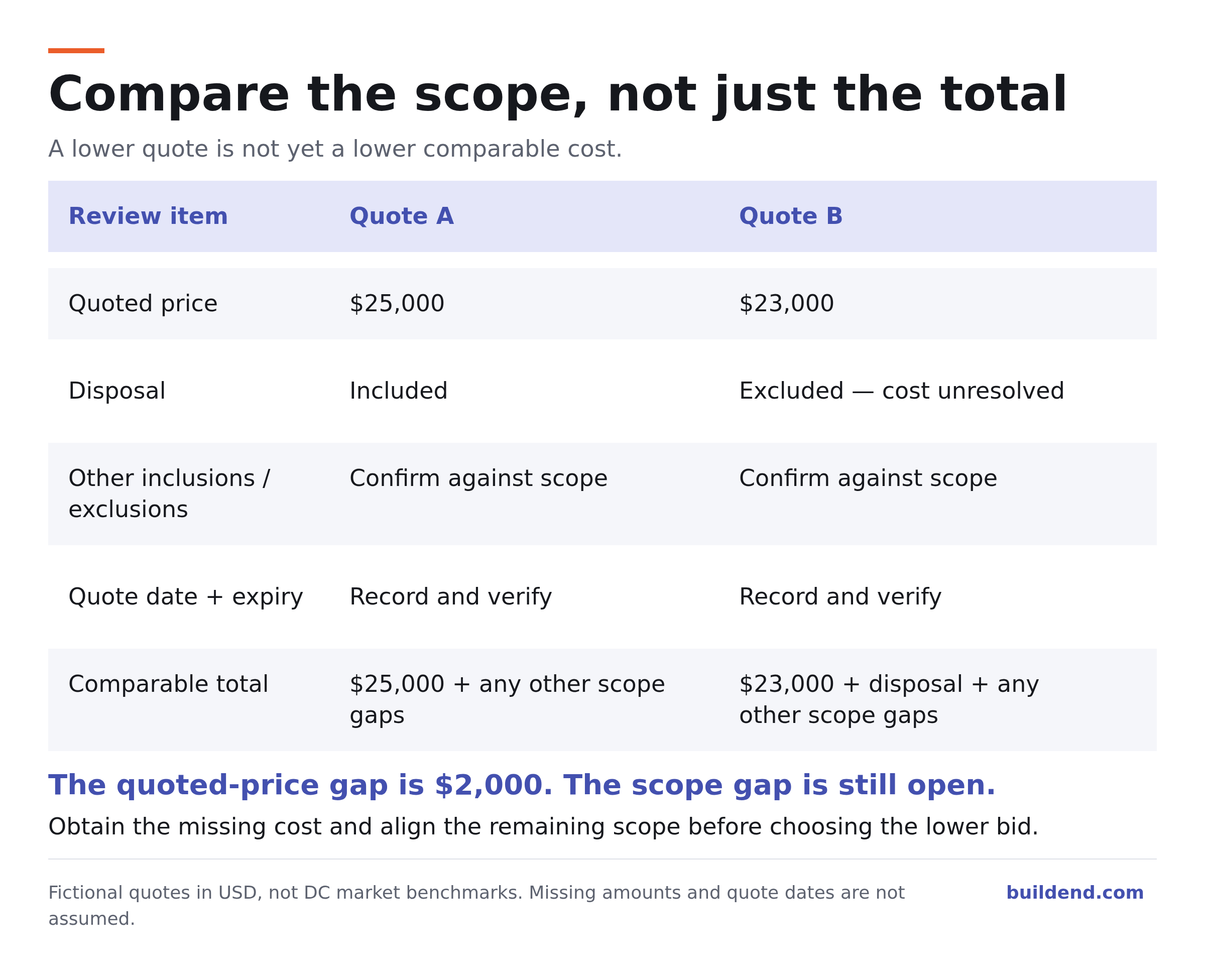
Figure 1. Compare inclusions, exclusions and quote validity before choosing the lower bid. The quoted-price gap is $2,000, but the missing disposal cost remains unresolved.
Keep unresolved scope visible. Request clarification, price a stated allowance, or identify an exclusion for agreement with the customer. A blank line is not a resolved assumption.
Confirm the pricing method at the same time. The National Association of Home Builders explains the difference between fixed-bid and cost-plus pricing. The example below assumes a fixed price for defined work. A cost-plus agreement instead needs an agreed cost-and-fee basis; unit pricing needs defined units and quantity assumptions.
Once the team agrees on what the price covers, calculate what that scope costs to deliver.
How to price a job in construction: calculate the complete cost
Add direct costs, job-specific indirect costs, allocated company overhead and an explicit risk allowance. Keep the categories separate so reviewers can check the assumptions without counting the same expense twice.
The National Association of Home Builders' job-costing course overview identifies labor burden, billable hours, indirect costs and overhead recovery as distinct parts of understanding job profitability. Your estimate needs the same clarity, even when the work starts in a spreadsheet.
Calculate labor from hours and burdened cost
Multiply estimated productive hours by a labor cost that includes the applicable employer costs. Use payroll and accounting records to establish the rate, and have production validate the hours, crew mix and working conditions. The US Bureau of Labor Statistics distinguishes wages from employer benefit costs, including paid leave, insurance, retirement contributions and legally required benefits. Use your company's applicable costs, not a national average, to build the rate.
For this fictional job, assume 1,000 productive labor hours at a fully burdened cost of $60 per productive hour. That produces a $60,000 labor estimate. Neither figure is a Washington, DC market benchmark.
Keep the units explicit. Quantity × hours per unit gives total hours. Quantity ÷ units completed per hour also gives total hours. Those are different ways of expressing productivity, not interchangeable formulas.
Match the rate to the hours: when a rate includes recovery of paid nonproductive time, do not add that same recovery again elsewhere. Ask accounting to confirm the treatment before using the rate across estimates.
Add the remaining costs without overlap
Use current quotes for materials, subcontractors and equipment, then add the costs not included in those quotes. Check waste, freight, applicable tax, rental duration and scope exclusions rather than assuming each supplier priced them identically.
The illustrative estimate uses these amounts, all in US dollars:
| Cost category | Amount |
|---|---|
| Burdened labor | $60,000 |
| Materials | $55,000 |
| Subcontractors | $25,000 |
| Equipment | $10,000 |
| Direct-cost subtotal | $150,000 |
| Job-specific indirect costs | $12,000 |
| Allocated company overhead | $18,000 |
| Risk allowance | $10,000 |
| Complete pricing cost base | $190,000 |
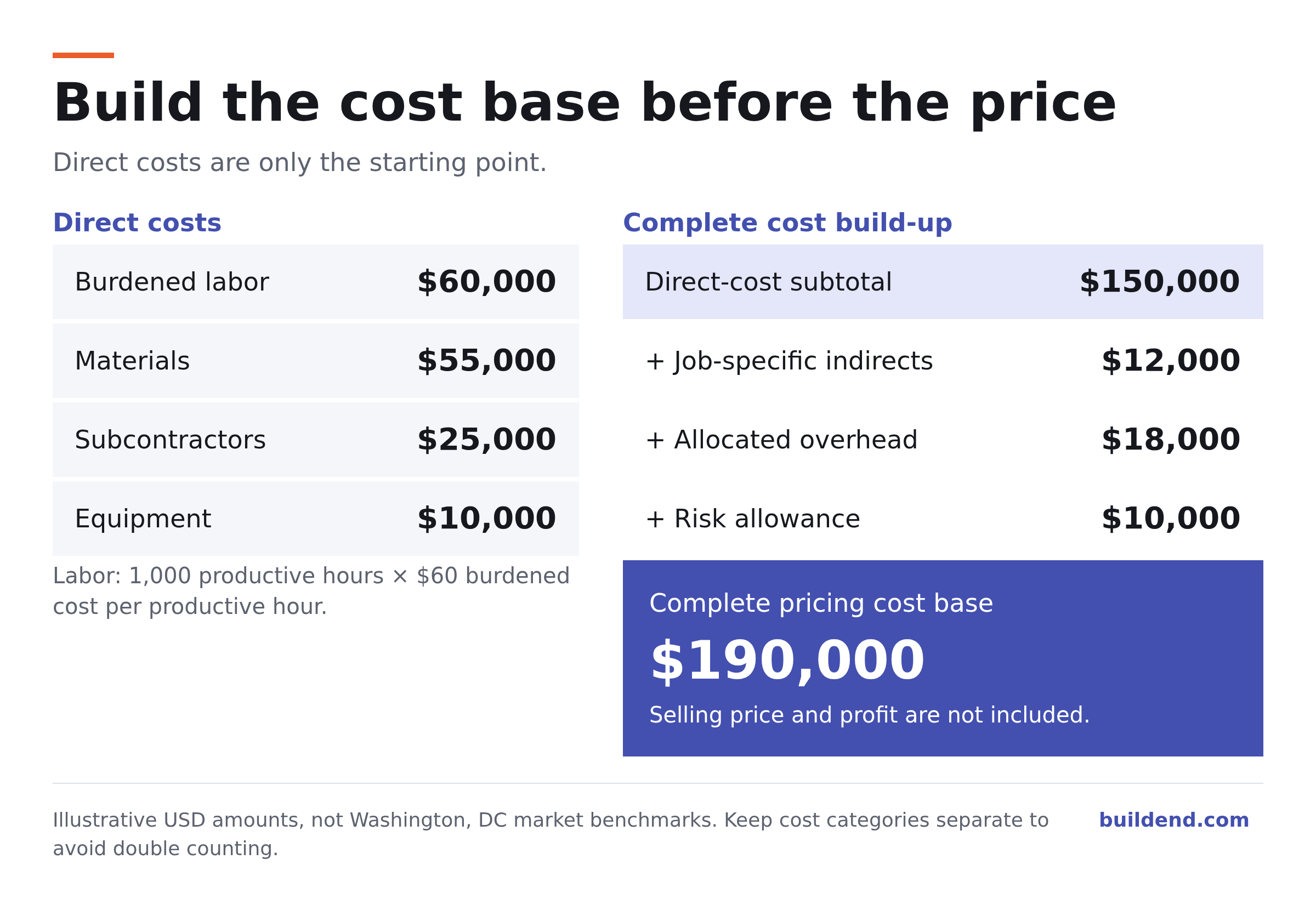
Figure 2. Build the complete cost base before setting the selling price. Illustrative US-dollar amounts, not Washington, DC market benchmarks.
Document how the $18,000 overhead allocation was calculated. For example, an assumed annual overhead budget of $360,000 divided by 20,000 productive field hours gives $18 per hour. Allocating that to this job's 1,000 hours produces $18,000. These are example assumptions, not a recommended allocation for every contractor.
Keep job supervision, equipment and insurance in their assigned categories. The same expense does not belong in both job costs and the overhead allocation. The $10,000 risk allowance is reserved for identified uncertainty, not profit or an expense already incurred.
Check local requirements and comparable work
Verify project-specific wage and tax requirements, then test the estimate against comparable completed work. Local compliance checks establish the applicable inputs; historical results help assess whether the quantities and hours are realistic.
For covered work, the US Department of Labor explains Davis-Bacon prevailing-wage and fringe-benefit requirements, including coverage of federal and District of Columbia contracts. Check the solicitation and applicable wage determination rather than applying an ordinary company rate automatically. This is not a rule that every private DC job has identical wage requirements.
For qualifying exempt purchases, DC's Office of Tax and Revenue requires contractor exemption documentation. Confirm eligibility and documentation before removing tax from a material allowance.
Compare the estimate with similar completed work using consistent construction cost codes. For example, keep formwork, reinforcement and concrete placement in matching categories across the estimate and actual-cost records. Compare hours and costs within the same scope, and account for changes in rates or site conditions before reusing an old allowance.
Beside each major cost, retain its source, date, unit, assumption owner and unresolved issue. Once those inputs support the $190,000 base, the next decision is the selling price.
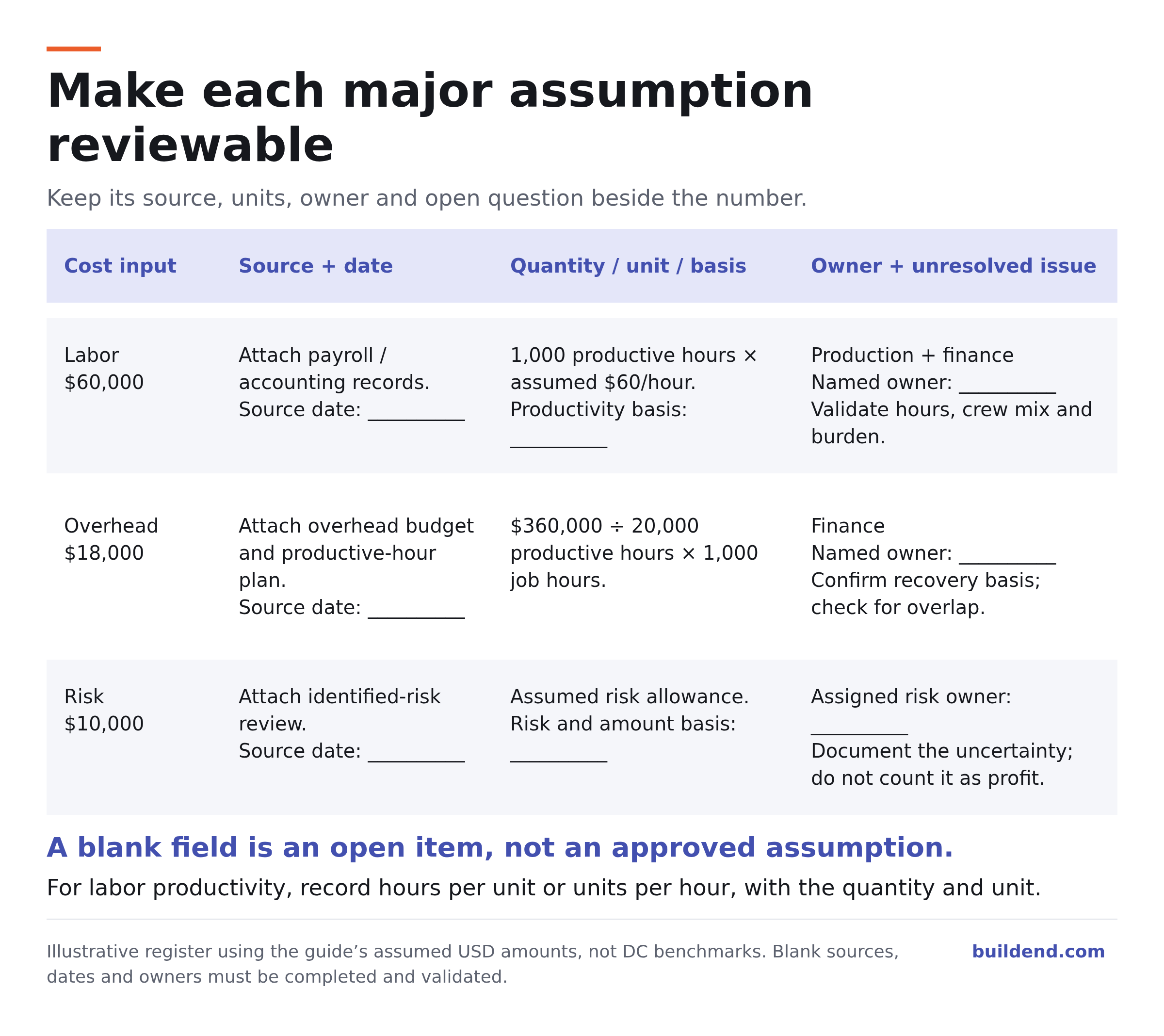
Figure 3. Make each major cost assumption reviewable. The example uses the guide’s assumed amounts; blank source, date, productivity and owner fields must be completed and validated.
Set the selling price without rewriting the cost estimate
Choose a defined profit target and calculate the price from the complete cost base. Keep a commercial concession separate from a genuine change in scope, productivity or purchasing cost.
Case made that distinction directly in his PowerTips interview:
“The estimated cost needs to be as accurate as possible.”
- Bruce Case, president and CEO, Case Design/Remodeling
He described addressing an unsellable price through a separate markup discussion, rather than pressuring the project manager to reduce necessary hours.
Define the percentage before calculating it
State which costs are included and whether the percentage applies to cost or selling price. Markup measures the amount added against cost; margin measures the difference against revenue. Buildend's markup and margin calculator converts between the two using your job cost and target percentage.
Here, the $190,000 base already includes allocated overhead and a risk allowance. Define the target as planned profit after those included costs and allowances, expressed as a percentage of selling price. Do not label it accounting gross margin or guaranteed realized net profit.
For an illustrative 20% target, use this calculation:
Selling price = $190,000 ÷ (1 − 0.20) = $237,500.
The difference is $47,500, equal to 20% of the selling price. Adding a 20% markup produces a different result:
| Calculation | Selling price | Amount above the $190,000 base | Share of selling price |
|---|---|---|---|
| Add 20% to cost | $228,000 | $38,000 | 16.67% |
| Target 20% of selling price | $237,500 | $47,500 | 20% |

Figure 4. Define the percentage before pricing the job. Each bar represents 100% of its own selling price; planned profit is after the costs and allowances included in this example.
These are calculated examples, not industry profit statistics. Actual costs and use of the risk allowance determine the eventual result.
If the customer rejects $237,500, review scope, procurement, schedule or the commercial target. Record a reduced-return decision as an exception; change estimated costs only when the underlying assumptions change. That distinction gives reviewers a clear decision to approve.
Review the assumptions and authorize the price
Validate the delivery plan separately from management's authorization of the selling price. Production confirms the work and hours; the authorized commercial approver accepts the planned return and any exception.
Case's historical approval process required production sign-off before presenting the sale and management approval for markup adjustments. Use that distinction without copying another company's deadlines or thresholds.
Assign these responsibilities in your own review process:
- Coordinator or estimator: assemble the current scope, takeoff, quotes and open questions.
- Production or project manager: validate labor hours, access, sequencing and exclusions.
- Accounting or finance: check burden, overhead, tax assumptions and category consistency.
- Authorized operations or management approver: approve the selling price and record commercial exceptions.
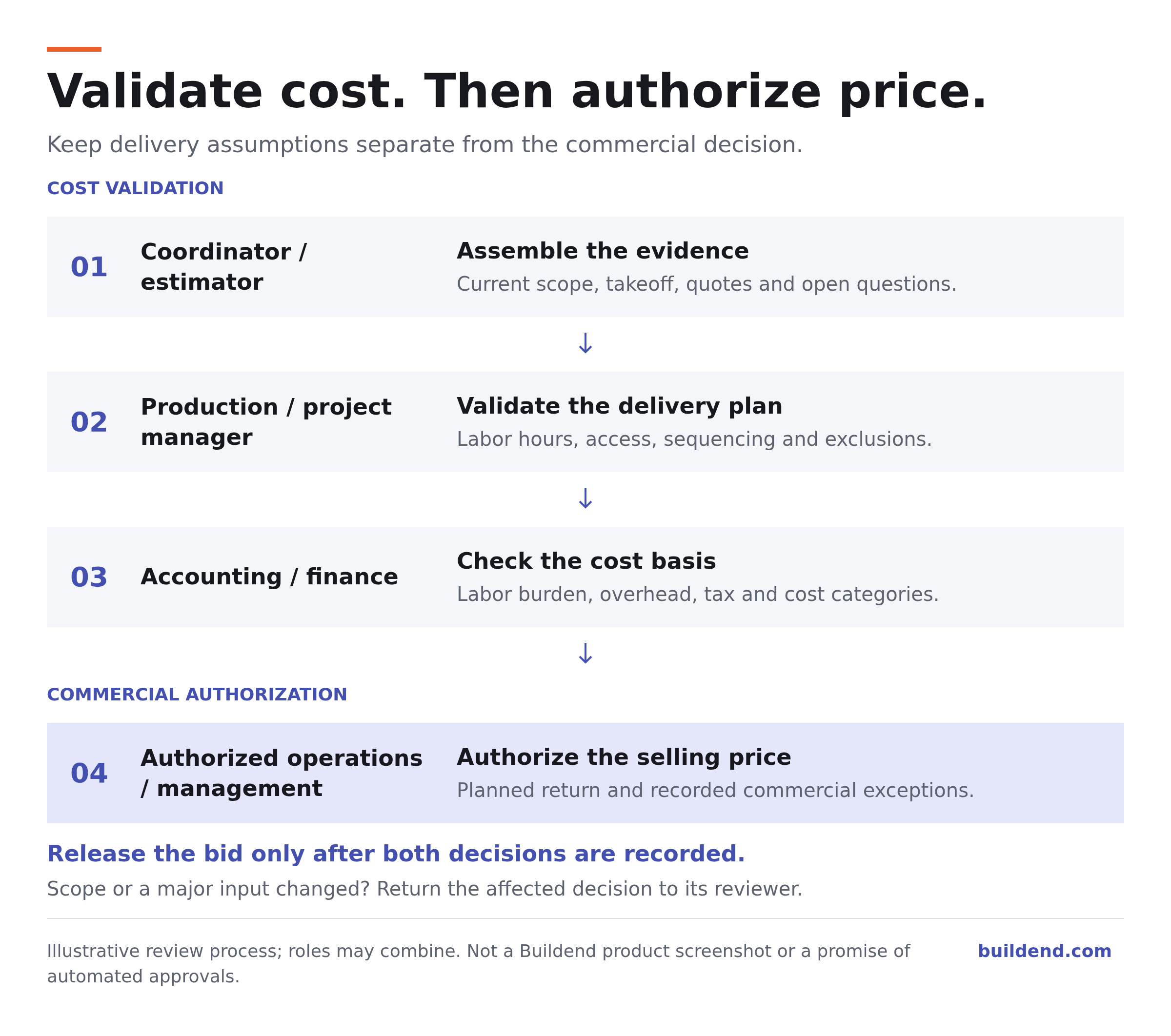
Figure 5. Validate delivery costs separately from authorizing the selling price. Roles may combine; this is an illustrative process, not a Buildend product screenshot or a promise of automated approvals.
Combine roles where appropriate, but identify who has authority to accept each decision. Set a review deadline before the customer submission date and name who resolves disagreements.
Release the bid only after the review answers these questions:
- Does the proposal match the priced scope and current revision?
- Are quotes current and exclusions resolved or disclosed?
- Has production accepted the labor and schedule assumptions?
- Are overhead, risk and the profit measure explicit?
- Are commercial exceptions authorized and recorded?
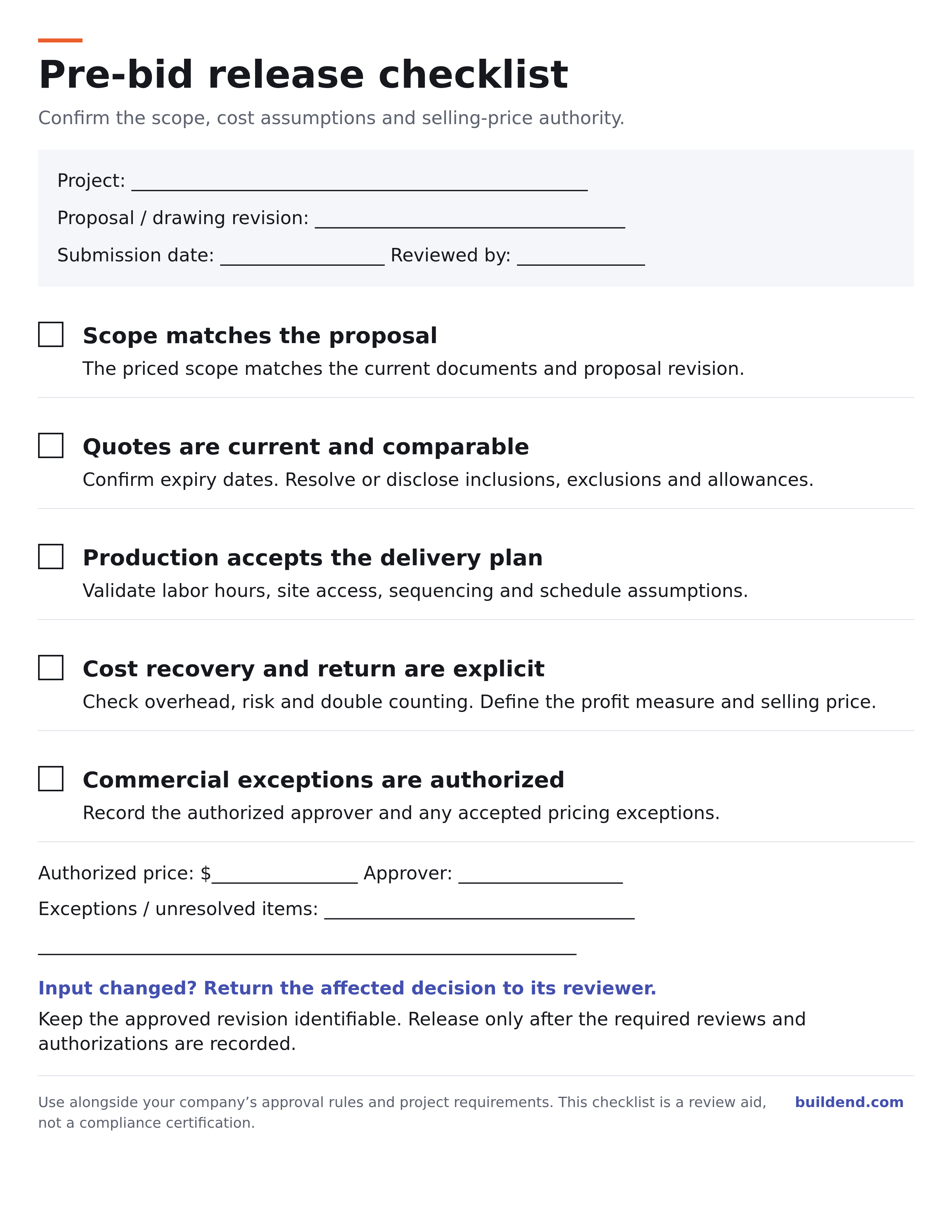
Figure 6. Use the pre-bid checklist alongside your company’s approval rules and project requirements. It is a review aid, not a compliance certification.
Download the one-page printable checklist (US Letter PDF).
If scope or a major input changes, return the affected decision to its reviewer. Keep the approved revision identifiable rather than leaving several different totals in circulation.
With those decisions recorded, submission follows an agreed price rather than an unresolved internal disagreement.
Apply the process to your next bid
Start with one live estimate and separate its cost assumptions from its selling-price approval. That is how to price a job in construction without treating a desired price as evidence of a lower delivery cost.
Ask production to validate the largest labor allowance. Ask finance to explain overhead recovery. Record who accepts the final return and any exception.
For a connected workflow, bring that estimate to a Buildend estimating demo. Ask the team to demonstrate your cost inputs, trade-bid comparison, review and approved-estimate handoff using your own project.